
Re-imagining analog reading
There is something magical about reading fiction. For a moment, you travel to another universe, without ever leaving your couch. You may finish a good book in a matter of days, but it will stay with you forever. My thesis explores how this magic can be enhanced with digital technologies.
I am passionate about reading and user experience design. I find the intersection of the two fascinating. I believe there are numerous opportunities to leverage the connected and sensing capabilities of the devices on which we are currently reading to create engaging stories and reading experiences.
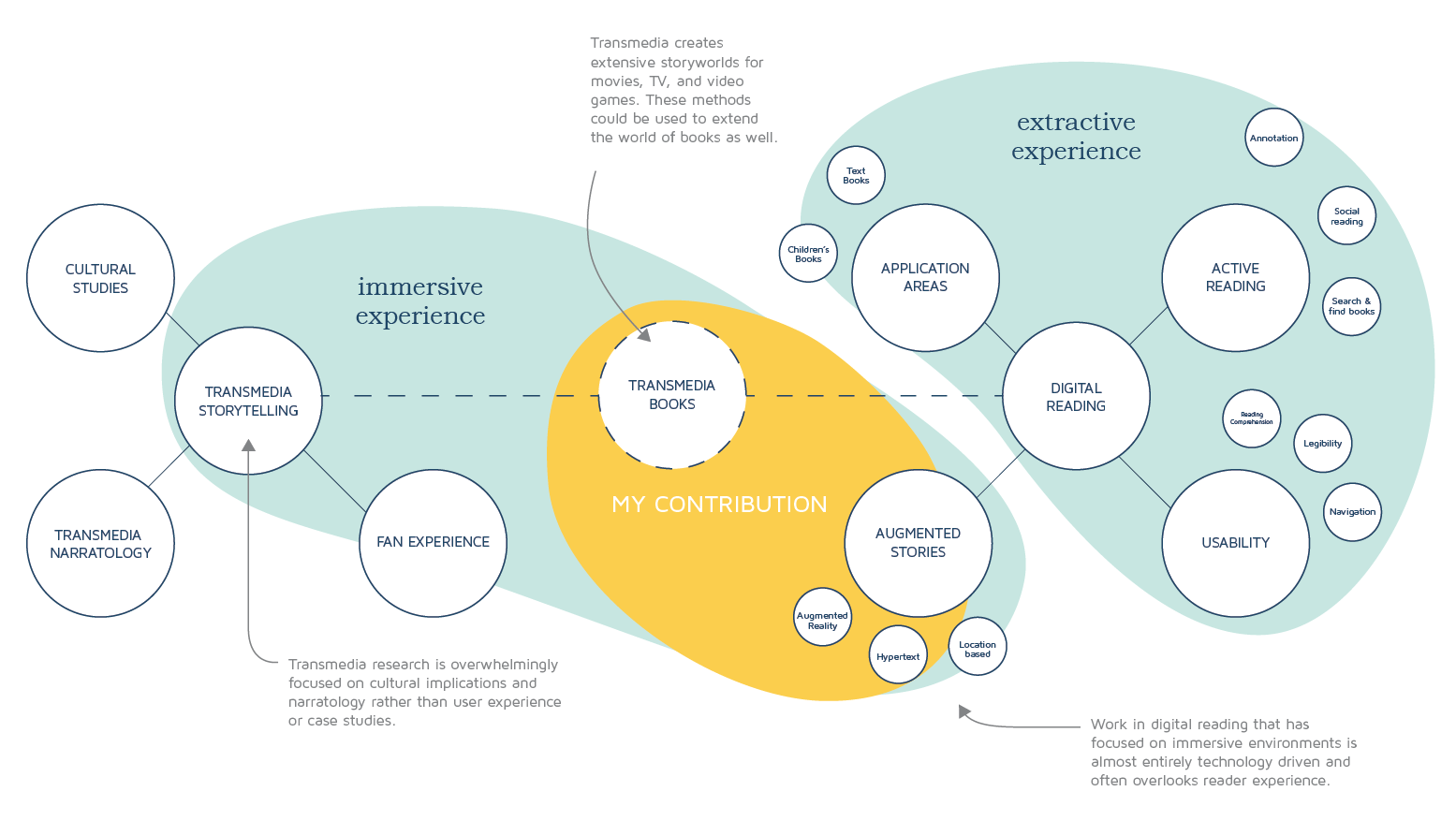
Electronic books have been created and studied for 30 years. However, the work is almost exclusively focused on active, extractive reading, not the immersive stories that people escape into every day. My research focuses on how and why people read, especially fiction. I also completed a review of current commercial and academic work, and explored how transmedia creates immersive story experiences surrounding films, television, and video games.

Literature review
My academic research looked at the design research surrounding digital books and transmedia storytelling. Design research on digital books has focused almost entirely on extractive reading, reading to learn or extract specific pieces of information.
On the other hand, Transmedia storytelling has been particularly effective in engaging fans in an immersive story experience. By using methods and ideas from transmedia storytelling and applying them to the digital reading experience I hoped to build an experience that immersed readers even deeper in a story.
Primary research
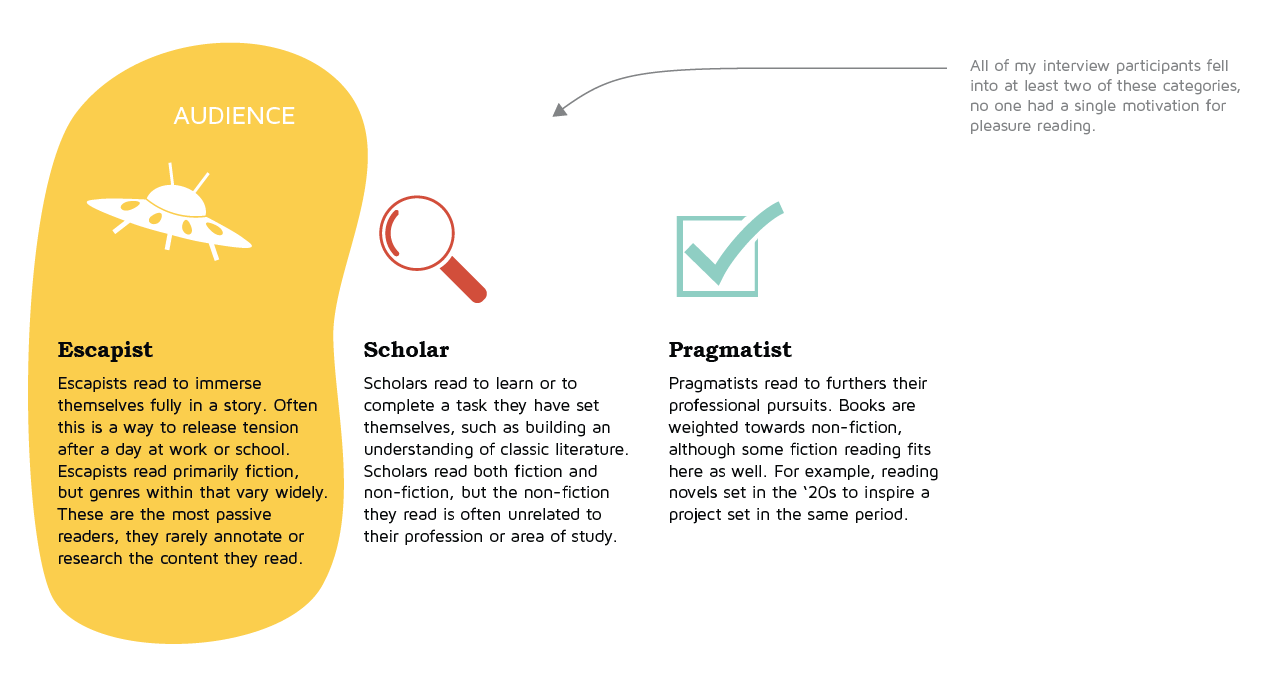
Three different motivations for pleasure reading emerged from my interviews, survey, and card sorting. Some participants were also required to read for classes, that motivation was not included in this framework as it was required reading and not chosen for pleasure. Unlike traditional user types, people often fall into multiple categories based on their motivations from book to book. Therefore I am referring to them as motivations.
Second screen prototype
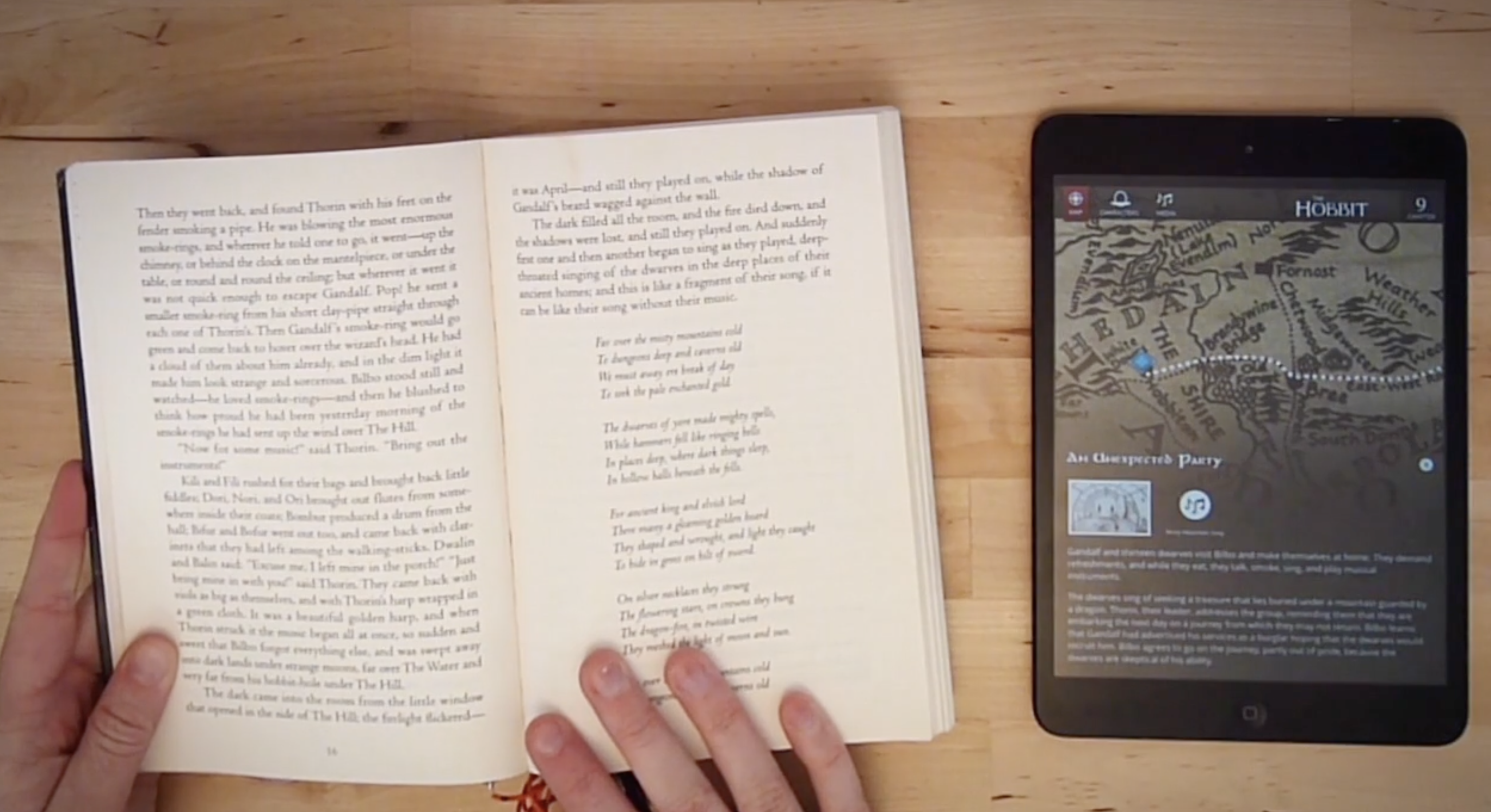
The prototype used Makey Makey to recognize pages in a copy of The Hobbit and update a second screen interface with context relevant content, namely a map that kept track of the location of the characters and updated with key plot points as the story progressed.
Prototyping this system, while I received good feedback, also helped me realize that a second screen is likely not the best way to deliver augmented content for a physical book. While the content was well received, it quickly became apparent that it was awkward to juggle two devices (a book and a tablet) while reading.
Projection Mapping Prototype
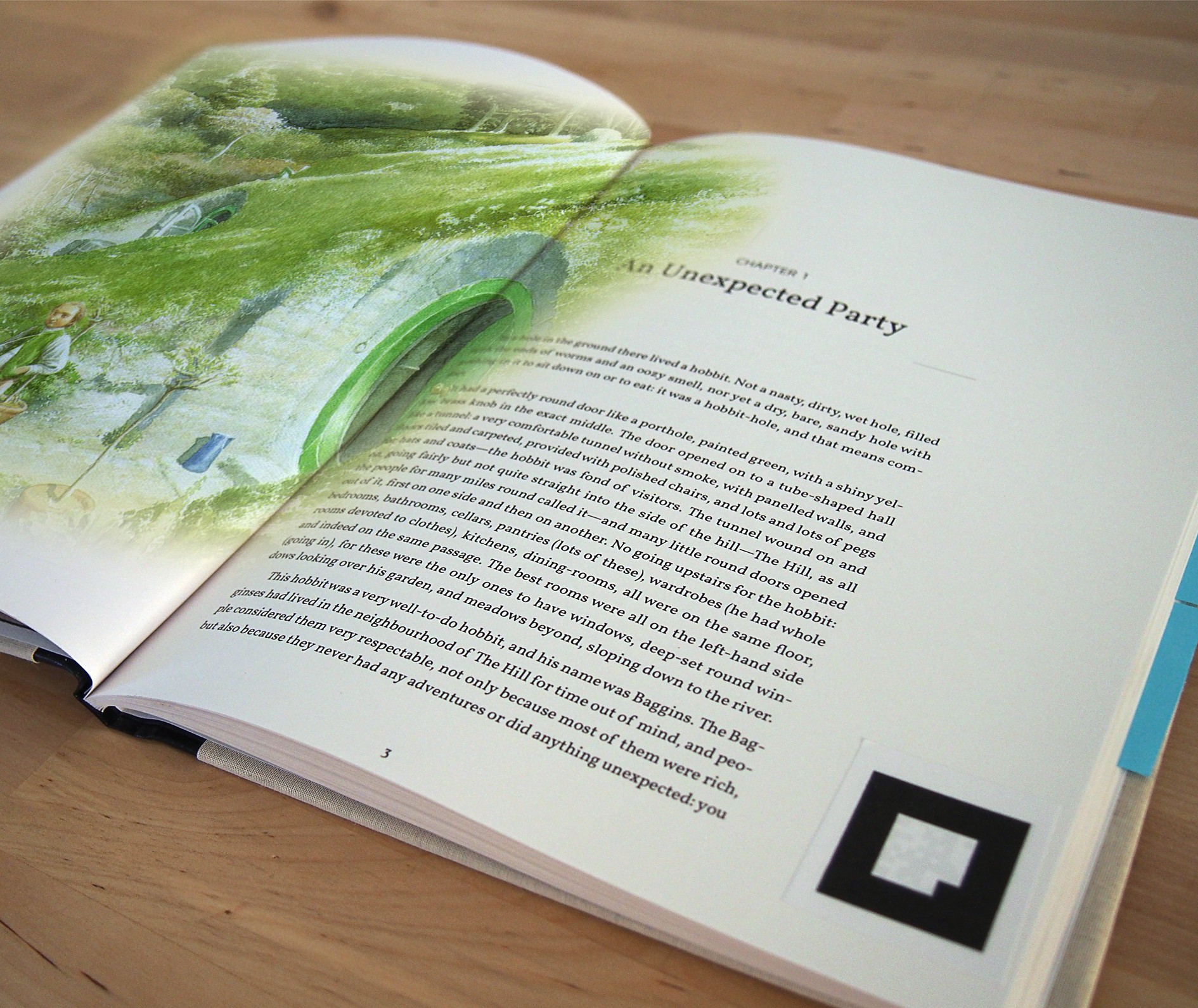
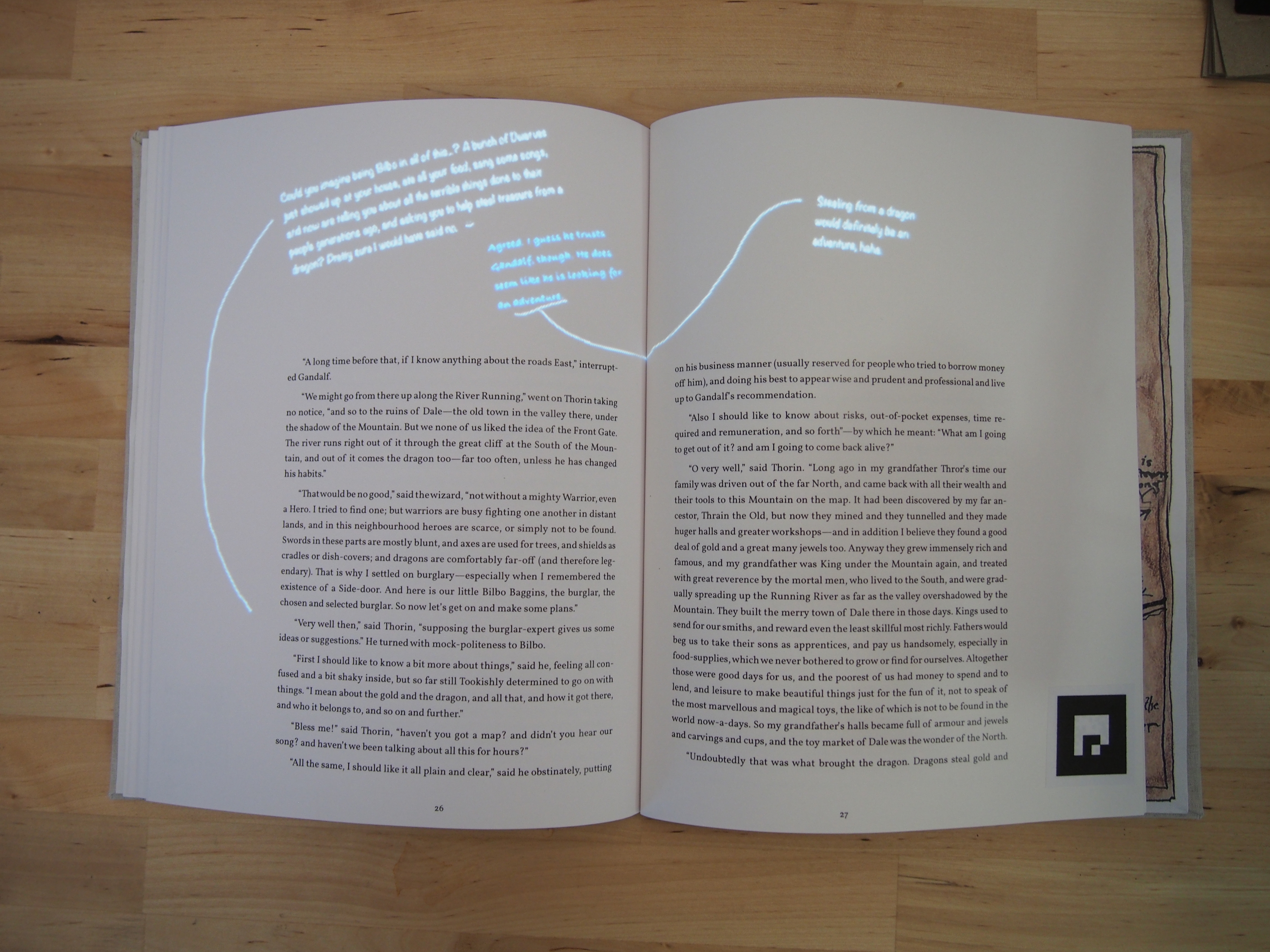
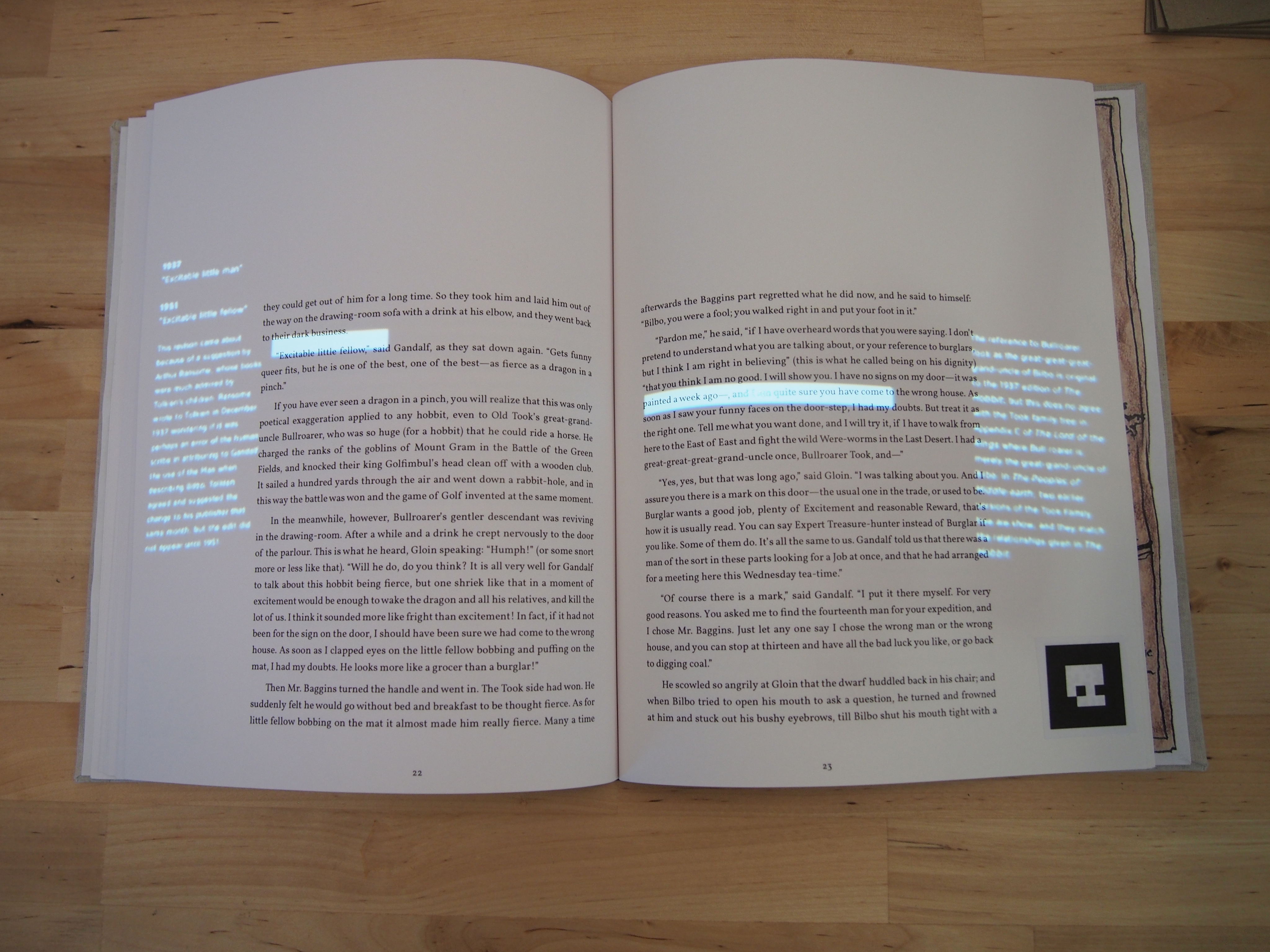
My projection mapping prototype primarily responds to my research finding that many readers prefer the experience of reading an analog book to reading on a tablet.
This prototype leveraged on screen graphic codes that could be picked up by a camera and an overhead projector that projected graphics, notes, and played music as a user flipped through pages of the book.
Layered Library App
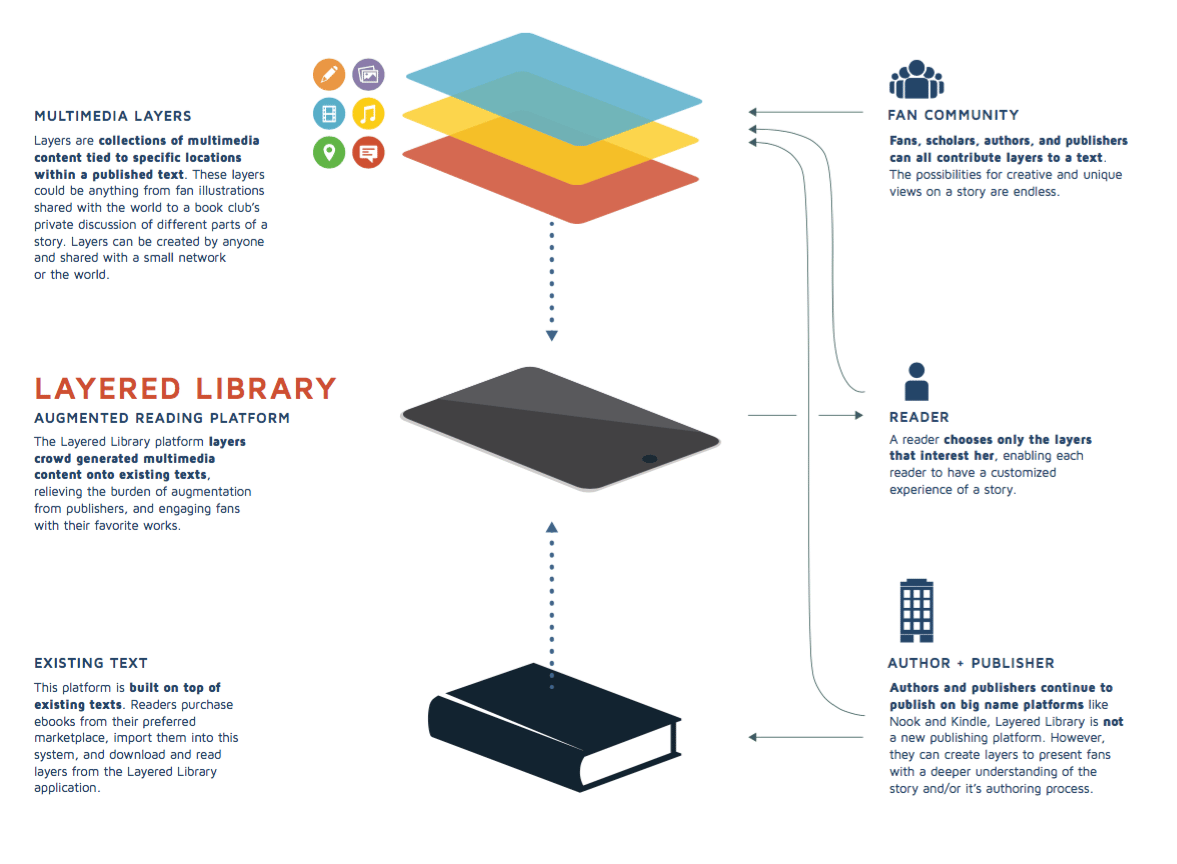
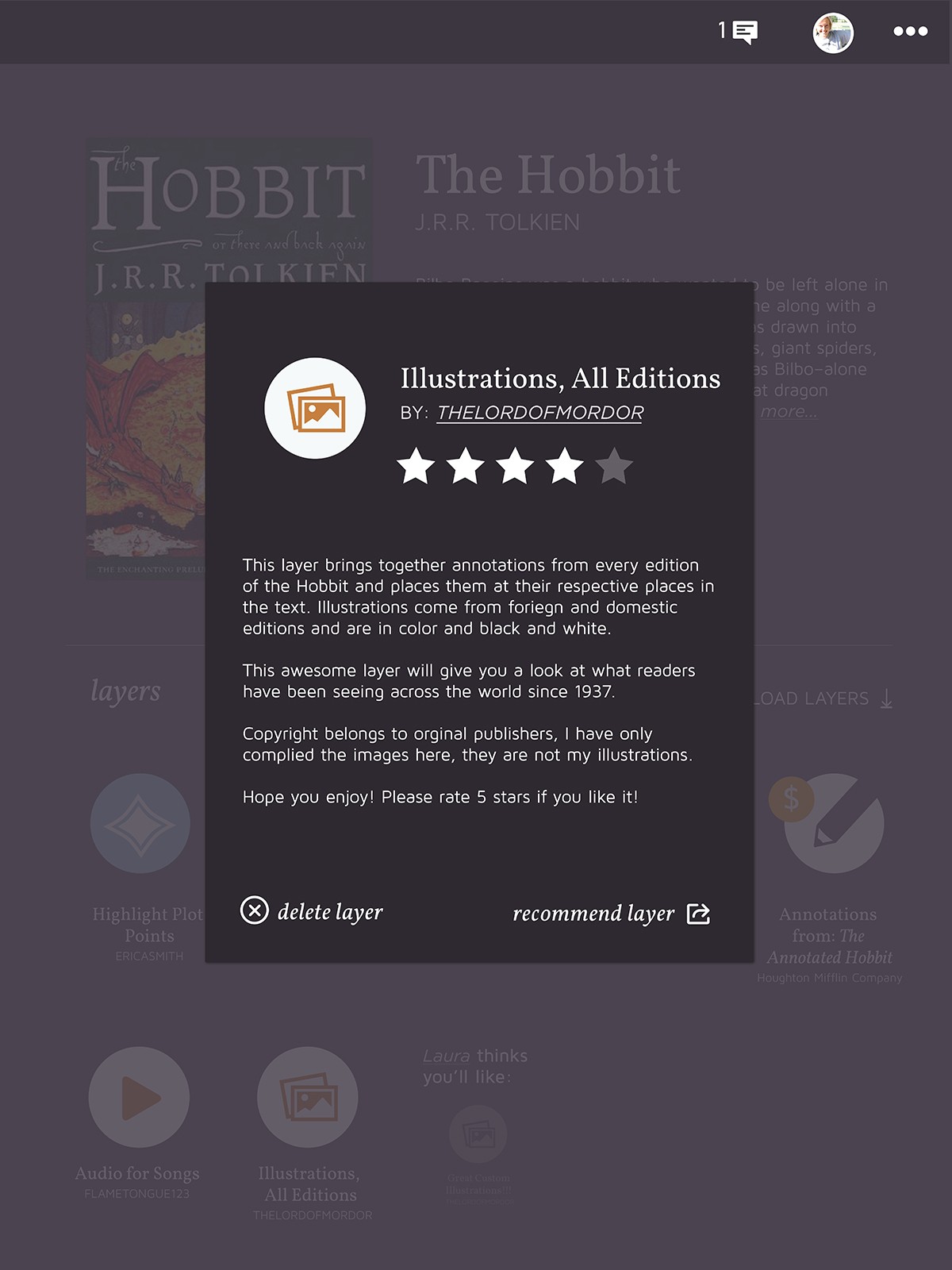
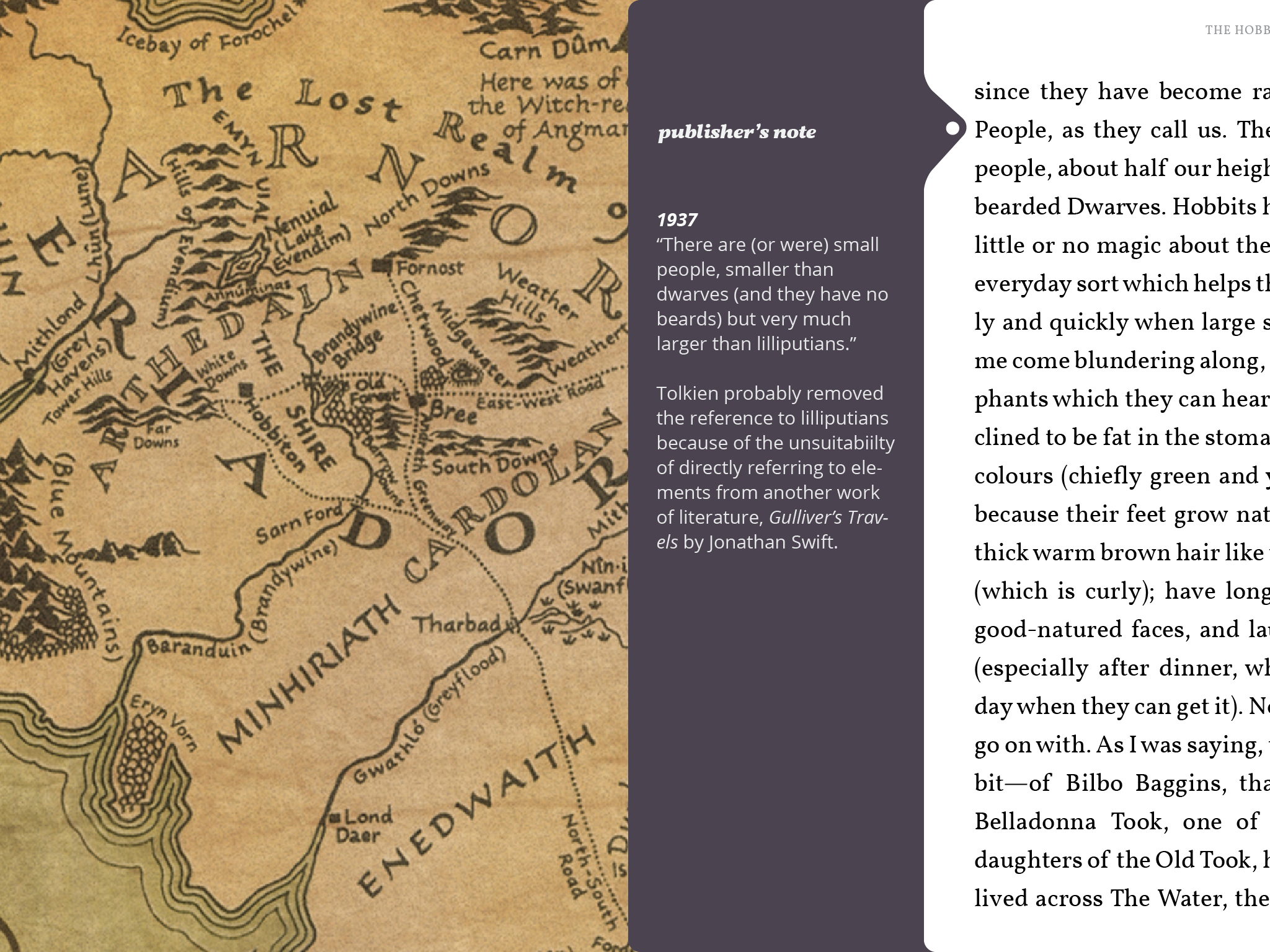
The Layered Library platform layers crowd-generated multimedia content onto existing books. This relieves the burden of augmentation from publishers, and engages fans and readers with their favorite works.
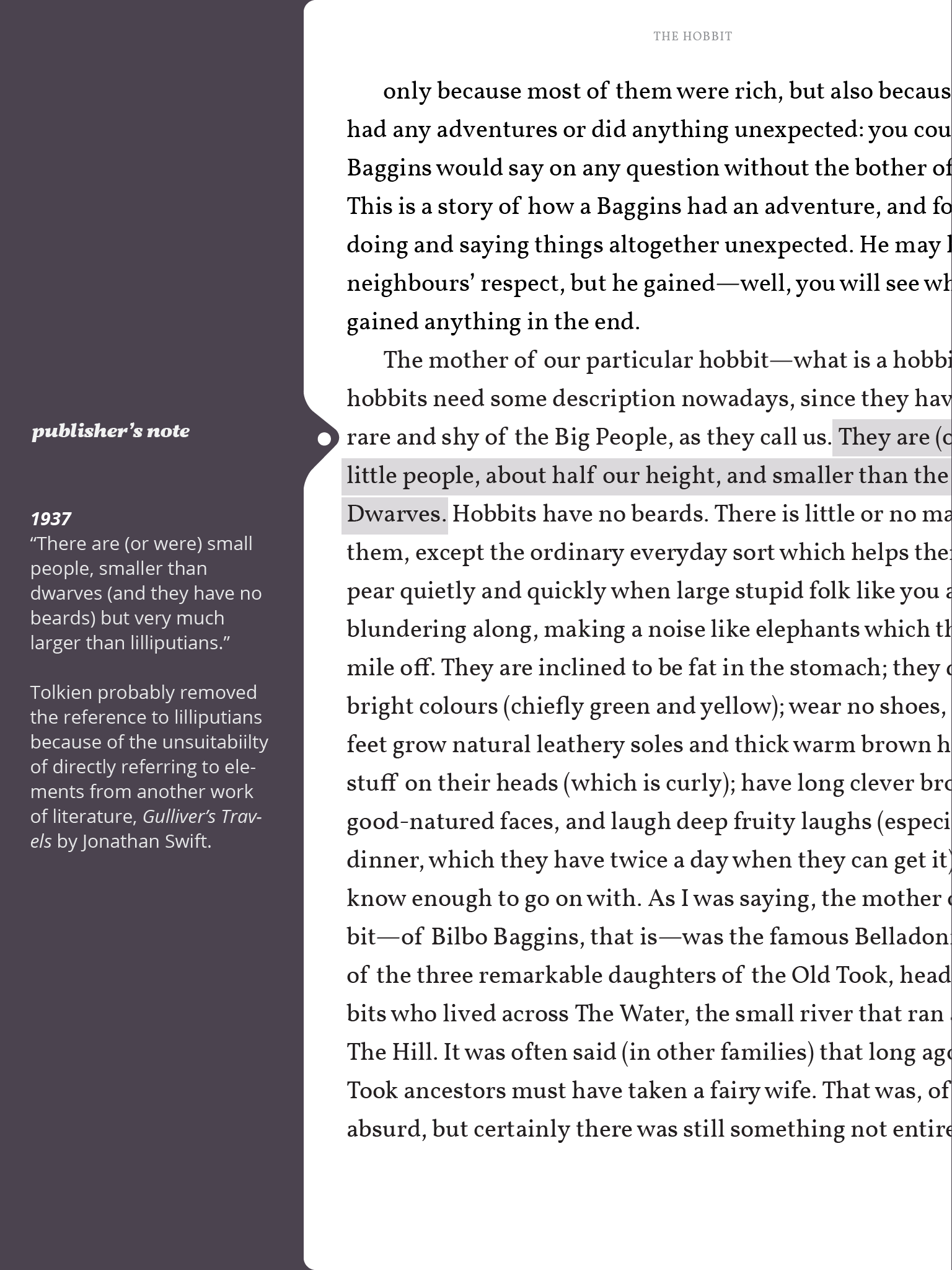
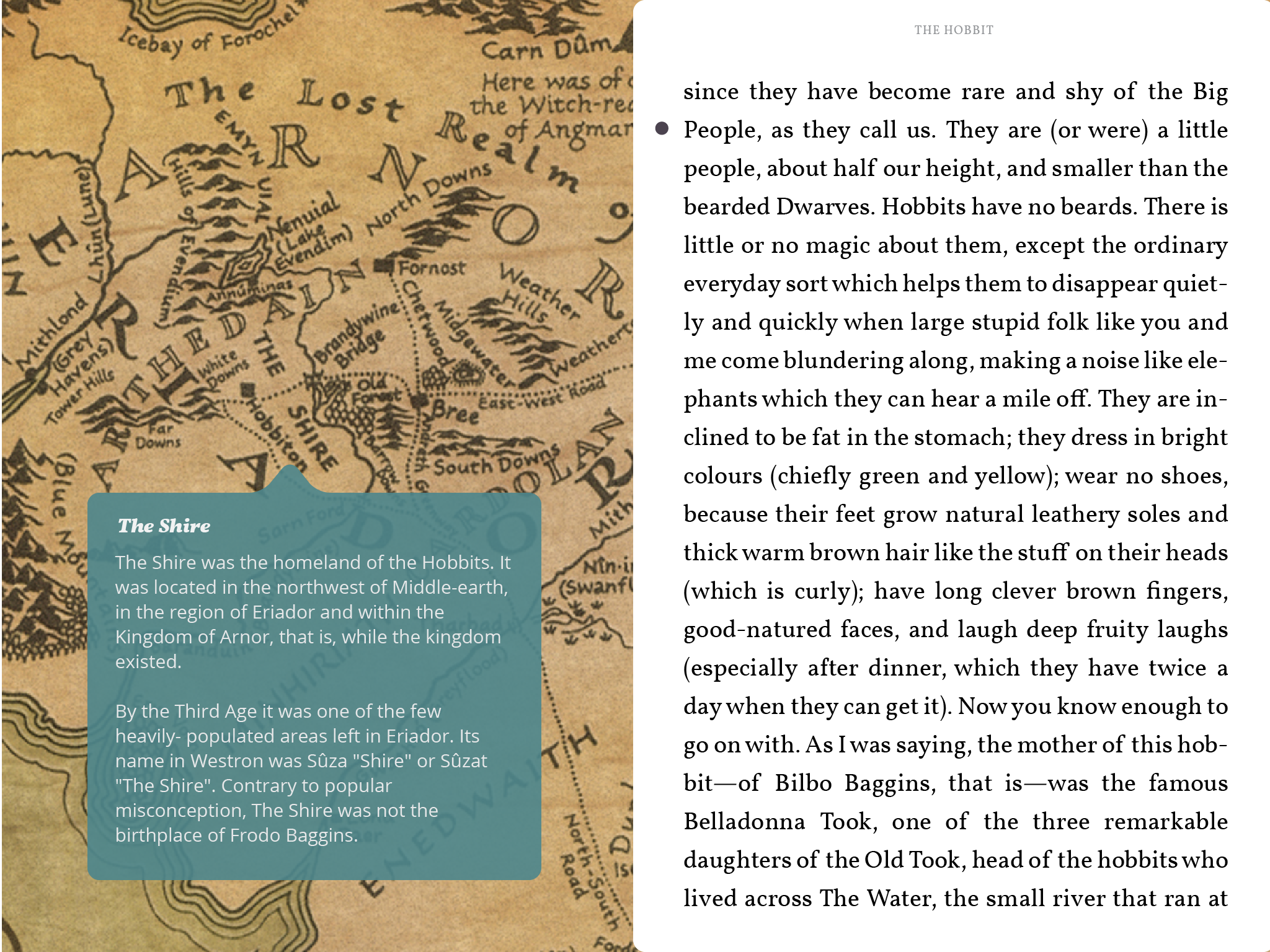
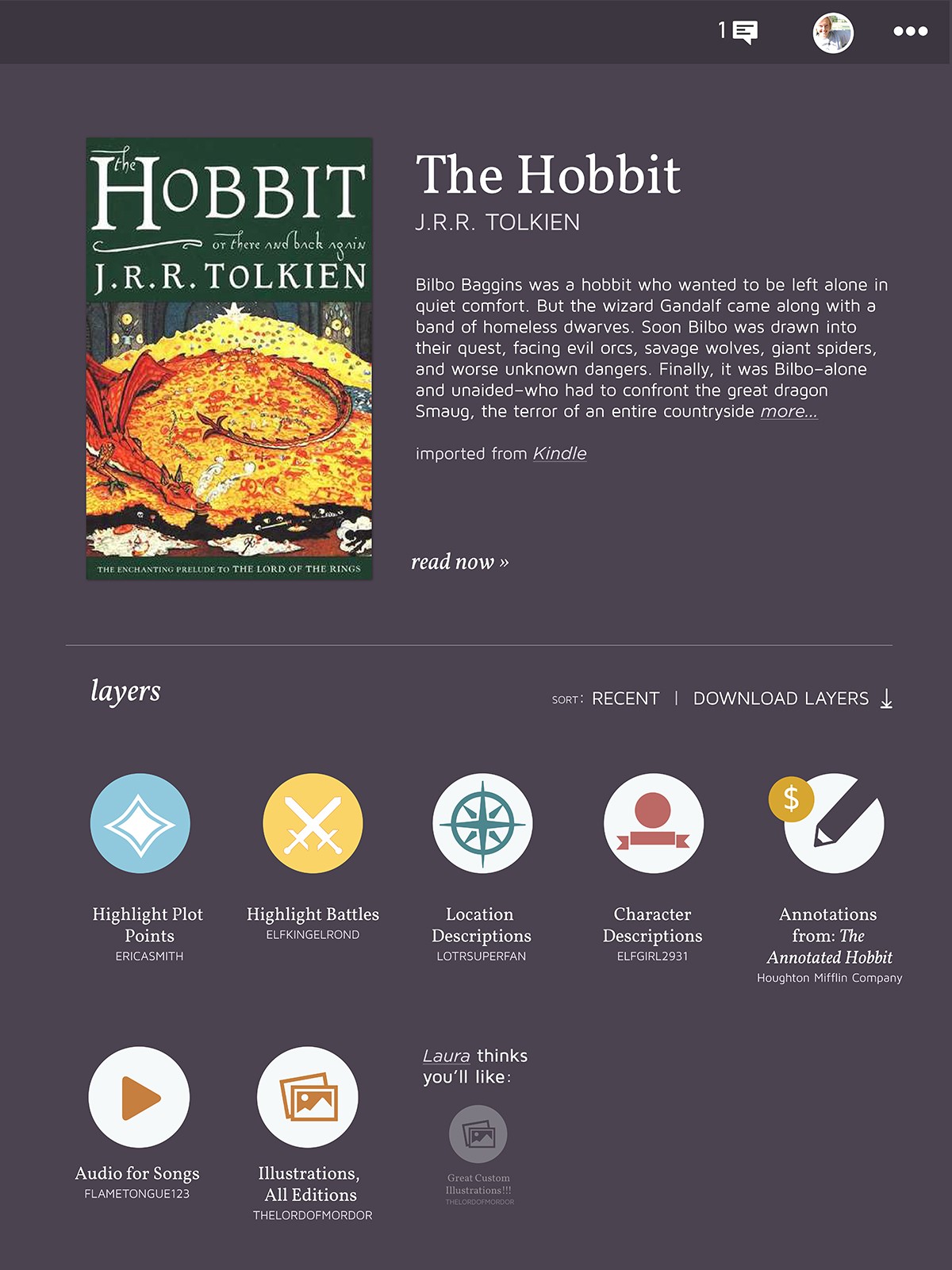
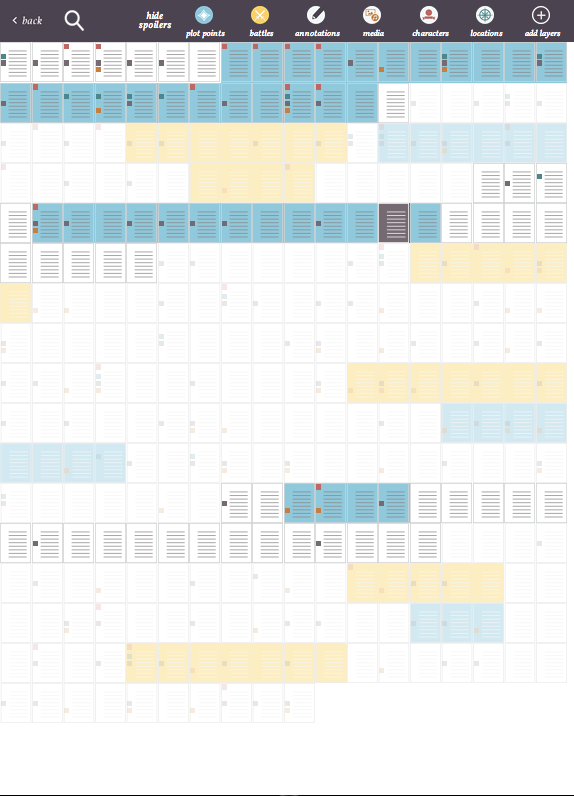
Layers are collections of multimedia content tied to specific locations within a published text. These layers can be anything from fan illustrations shared with the world to a book club’s private discussion of di erent parts of a story. Layers can take the form of comments and annotationson a text or deeper information about the story such as character or location descriptions.
Fans, scholars, authors, and publishers can all contribute layers to a text and readers choose only the layers that interest them, enabling each reader to have a customized experience of a story. Many fan communities currently exist to talk about their favorite stories and franchises.
By tapping into this collective intelligence and tying the information to specic locations within a text the Layered Library makes the wide variety information generated by fan communities accessible to all readers exactly when it is relevant.
Evaluative research
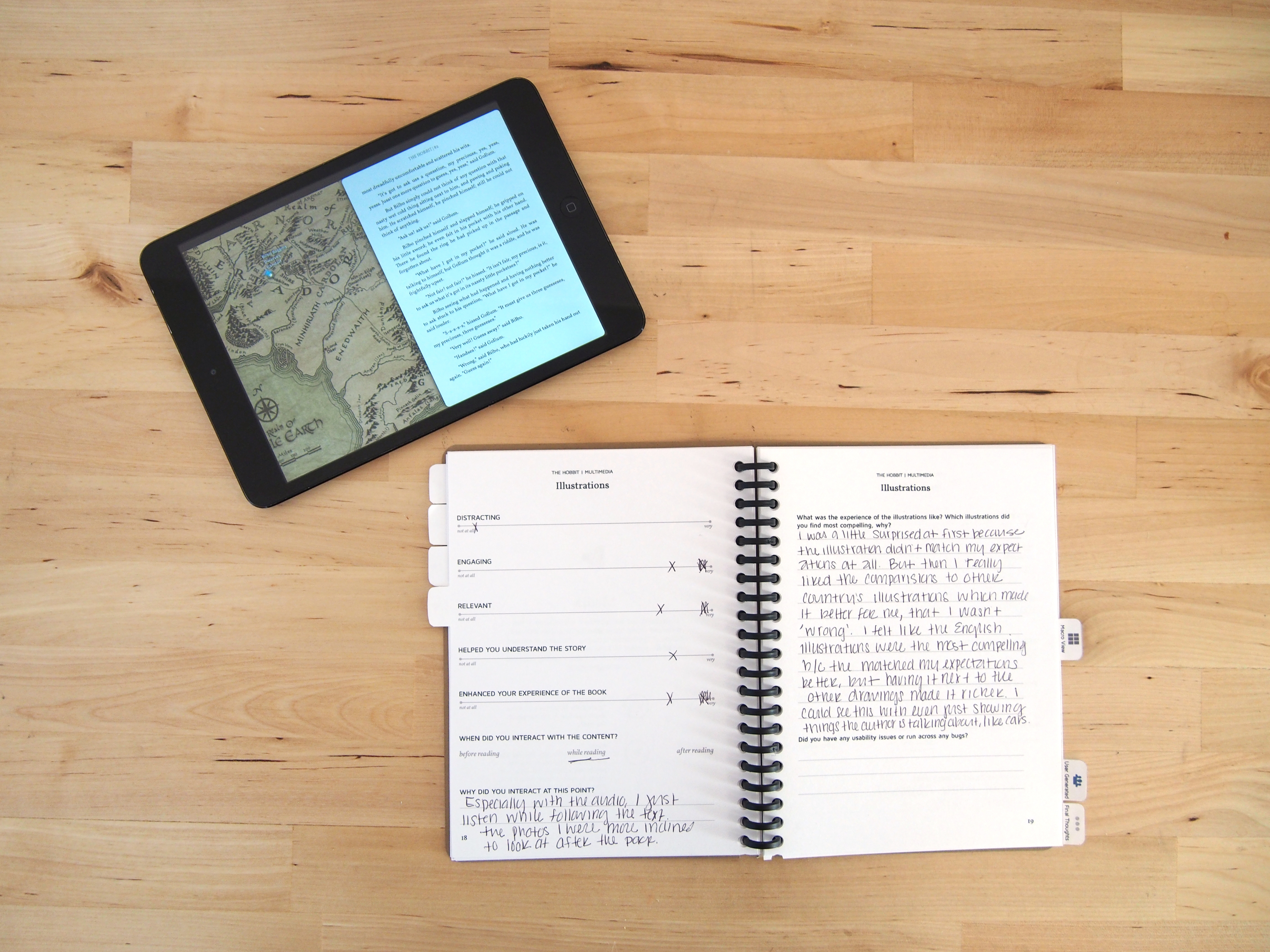
My mobile Layered Library prototype was the focus of my evaluative research. Because it is the most throughly designed and developed, I was able to evaluate it for desirability, viability, and usability. My physical prototypes were evaluated informally through demos and group feedback sessions.
To evaluate my mobile prototype I provided five research participants with a working prototype of three chapters of The Hobbit and 6 different layers. They were given a journal study to fill out asking them to reflect on their experience with the prototype and then participated in a 30 minute post-use interview where I asked in depth questions about their experience and how they could see the system scaling in the future.
Conclusion & Reflection
This project was an immense undertaking and an unparalleled learning experience for me. I learned about reading, about design, about prototyping as well as countless other topics. But along with my own learning, I believe that this project and the process that I followed has generated a number of unique contributions and could impact how we think about reading, content generation, and the development of reading experiences.
The solution itself represents a new way to read books, augmented with an unending variety of content. The content production and distribution model, a platform that leverages the collective intelligence and artistic talent of fans, scholars, publishers and authors, is unprecedented in current digital literature. And finally, my reader centered design process provided insight into how readers engage with books now and how they would like to engage with them in the future, leading to a far different outcome than I may have generated using a traditional authoring process.
This project was quite an adventure. I didn’t really know where I was going to end up, but I am happy with both the journey and the destination. Despite moments (or weeks) of self doubt and dissatisfaction with my work I made it through with a project I am very proud of. Honestly, it is not the project I thought I would end up with, but I guess that is a testament to the design process and staying confident that everything will work out in the end.
Re-imagining analog reading
There is something magical about reading fiction. For a moment, you travel to another universe, without ever leaving your couch. You may finish a good book in a matter of days, but it will stay with you forever. My thesis explores how this magic can be enhanced with digital technologies.
I am passionate about reading and user experience design. I find the intersection of the two fascinating. I believe there are numerous opportunities to leverage the connected and sensing capabilities of the devices on which we are currently reading to create engaging stories and reading experiences.
Electronic books have been created and studied for 30 years. However, the work is almost exclusively focused on active, extractive reading, not the immersive stories that people escape into every day. My research focuses on how and why people read, especially fiction. I also completed a review of current commercial and academic work, and explored how transmedia creates immersive story experiences surrounding films, television, and video games.

Literature review
My academic research looked at the design research surrounding digital books and transmedia storytelling. Design research on digital books has focused almost entirely on extractive reading, reading to learn or extract specific pieces of information.
On the other hand, Transmedia storytelling has been particularly effective in engaging fans in an immersive story experience. By using methods and ideas from transmedia storytelling and applying them to the digital reading experience I hoped to build an experience that immersed readers even deeper in a story.
Primary research
Three different motivations for pleasure reading emerged from my interviews, survey, and card sorting. Some participants were also required to read for classes, that motivation was not included in this framework as it was required reading and not chosen for pleasure. Unlike traditional user types, people often fall into multiple categories based on their motivations from book to book. Therefore I am referring to them as motivations.
Second screen prototype
The prototype used Makey Makey to recognize pages in a copy of The Hobbit and update a second screen interface with context relevant content, namely a map that kept track of the location of the characters and updated with key plot points as the story progressed.
Prototyping this system, while I received good feedback, also helped me realize that a second screen is likely not the best way to deliver augmented content for a physical book. While the content was well received, it quickly became apparent that it was awkward to juggle two devices (a book and a tablet) while reading.
Projection Mapping Prototype
My projection mapping prototype primarily responds to my research finding that many readers prefer the experience of reading an analog book to reading on a tablet.
This prototype leveraged on screen graphic codes that could be picked up by a camera and an overhead projector that projected graphics, notes, and played music as a user flipped through pages of the book.
Layered Library App
The Layered Library platform layers crowd-generated multimedia content onto existing books. This relieves the burden of augmentation from publishers, and engages fans and readers with their favorite works.
Layers are collections of multimedia content tied to specific locations within a published text. These layers can be anything from fan illustrations shared with the world to a book club’s private discussion of di erent parts of a story. Layers can take the form of comments and annotationson a text or deeper information about the story such as character or location descriptions.
Fans, scholars, authors, and publishers can all contribute layers to a text and readers choose only the layers that interest them, enabling each reader to have a customized experience of a story. Many fan communities currently exist to talk about their favorite stories and franchises.
By tapping into this collective intelligence and tying the information to specic locations within a text the Layered Library makes the wide variety information generated by fan communities accessible to all readers exactly when it is relevant.
Evaluative research
My mobile Layered Library prototype was the focus of my evaluative research. Because it is the most throughly designed and developed, I was able to evaluate it for desirability, viability, and usability. My physical prototypes were evaluated informally through demos and group feedback sessions.
To evaluate my mobile prototype I provided five research participants with a working prototype of three chapters of The Hobbit and 6 different layers. They were given a journal study to fill out asking them to reflect on their experience with the prototype and then participated in a 30 minute post-use interview where I asked in depth questions about their experience and how they could see the system scaling in the future.
Conclusion & Reflection
This project was an immense undertaking and an unparalleled learning experience for me. I learned about reading, about design, about prototyping as well as countless other topics. But along with my own learning, I believe that this project and the process that I followed has generated a number of unique contributions and could impact how we think about reading, content generation, and the development of reading experiences.
The solution itself represents a new way to read books, augmented with an unending variety of content. The content production and distribution model, a platform that leverages the collective intelligence and artistic talent of fans, scholars, publishers and authors, is unprecedented in current digital literature. And finally, my reader centered design process provided insight into how readers engage with books now and how they would like to engage with them in the future, leading to a far different outcome than I may have generated using a traditional authoring process.
This project was quite an adventure. I didn’t really know where I was going to end up, but I am happy with both the journey and the destination. Despite moments (or weeks) of self doubt and dissatisfaction with my work I made it through with a project I am very proud of. Honestly, it is not the project I thought I would end up with, but I guess that is a testament to the design process and staying confident that everything will work out in the end.
Re-imagining analog reading
There is something magical about reading fiction. For a moment, you travel to another universe, without ever leaving your couch. You may finish a good book in a matter of days, but it will stay with you forever. My thesis explores how this magic can be enhanced with digital technologies.
I am passionate about reading and user experience design. I find the intersection of the two fascinating. I believe there are numerous opportunities to leverage the connected and sensing capabilities of the devices on which we are currently reading to create engaging stories and reading experiences.
Electronic books have been created and studied for 30 years. However, the work is almost exclusively focused on active, extractive reading, not the immersive stories that people escape into every day. My research focuses on how and why people read, especially fiction. I also completed a review of current commercial and academic work, and explored how transmedia creates immersive story experiences surrounding films, television, and video games.

Literature review
My academic research looked at the design research surrounding digital books and transmedia storytelling. Design research on digital books has focused almost entirely on extractive reading, reading to learn or extract specific pieces of information.
On the other hand, Transmedia storytelling has been particularly effective in engaging fans in an immersive story experience. By using methods and ideas from transmedia storytelling and applying them to the digital reading experience I hoped to build an experience that immersed readers even deeper in a story.
Primary research
Three different motivations for pleasure reading emerged from my interviews, survey, and card sorting. Some participants were also required to read for classes, that motivation was not included in this framework as it was required reading and not chosen for pleasure. Unlike traditional user types, people often fall into multiple categories based on their motivations from book to book. Therefore I am referring to them as motivations.
Second screen prototype
The prototype used Makey Makey to recognize pages in a copy of The Hobbit and update a second screen interface with context relevant content, namely a map that kept track of the location of the characters and updated with key plot points as the story progressed.
Prototyping this system, while I received good feedback, also helped me realize that a second screen is likely not the best way to deliver augmented content for a physical book. While the content was well received, it quickly became apparent that it was awkward to juggle two devices (a book and a tablet) while reading.
Projection Mapping Prototype
My projection mapping prototype primarily responds to my research finding that many readers prefer the experience of reading an analog book to reading on a tablet.
This prototype leveraged on screen graphic codes that could be picked up by a camera and an overhead projector that projected graphics, notes, and played music as a user flipped through pages of the book.
Layered Library App
The Layered Library platform layers crowd-generated multimedia content onto existing books. This relieves the burden of augmentation from publishers, and engages fans and readers with their favorite works.
Layers are collections of multimedia content tied to specific locations within a published text. These layers can be anything from fan illustrations shared with the world to a book club’s private discussion of di erent parts of a story. Layers can take the form of comments and annotationson a text or deeper information about the story such as character or location descriptions.
Fans, scholars, authors, and publishers can all contribute layers to a text and readers choose only the layers that interest them, enabling each reader to have a customized experience of a story. Many fan communities currently exist to talk about their favorite stories and franchises.
By tapping into this collective intelligence and tying the information to specic locations within a text the Layered Library makes the wide variety information generated by fan communities accessible to all readers exactly when it is relevant.
Evaluative research
My mobile Layered Library prototype was the focus of my evaluative research. Because it is the most throughly designed and developed, I was able to evaluate it for desirability, viability, and usability. My physical prototypes were evaluated informally through demos and group feedback sessions.
To evaluate my mobile prototype I provided five research participants with a working prototype of three chapters of The Hobbit and 6 different layers. They were given a journal study to fill out asking them to reflect on their experience with the prototype and then participated in a 30 minute post-use interview where I asked in depth questions about their experience and how they could see the system scaling in the future.
Conclusion & Reflection
This project was an immense undertaking and an unparalleled learning experience for me. I learned about reading, about design, about prototyping as well as countless other topics. But along with my own learning, I believe that this project and the process that I followed has generated a number of unique contributions and could impact how we think about reading, content generation, and the development of reading experiences.
The solution itself represents a new way to read books, augmented with an unending variety of content. The content production and distribution model, a platform that leverages the collective intelligence and artistic talent of fans, scholars, publishers and authors, is unprecedented in current digital literature. And finally, my reader centered design process provided insight into how readers engage with books now and how they would like to engage with them in the future, leading to a far different outcome than I may have generated using a traditional authoring process.
This project was quite an adventure. I didn’t really know where I was going to end up, but I am happy with both the journey and the destination. Despite moments (or weeks) of self doubt and dissatisfaction with my work I made it through with a project I am very proud of. Honestly, it is not the project I thought I would end up with, but I guess that is a testament to the design process and staying confident that everything will work out in the end.